2023 / Establishing the collaboration
Project planning, industry consultation and initial sample collection.

Project overview · 2023–2025
AI-based Non-Invasive Grading System for Durian
Durian grading depends on the fruit’s maturity, ripeness, surface condition, shape and locule structure. Much of that judgment relies on experienced classifiers. AIDurian investigates how imaging, sound and machine learning can support a more documented assessment.
The project brought together UP Mindanao’s computing and postharvest researchers with Davao’s durian industry. Its approved research scope is a laboratory prototype for harvested Puyat durian.
Read the findings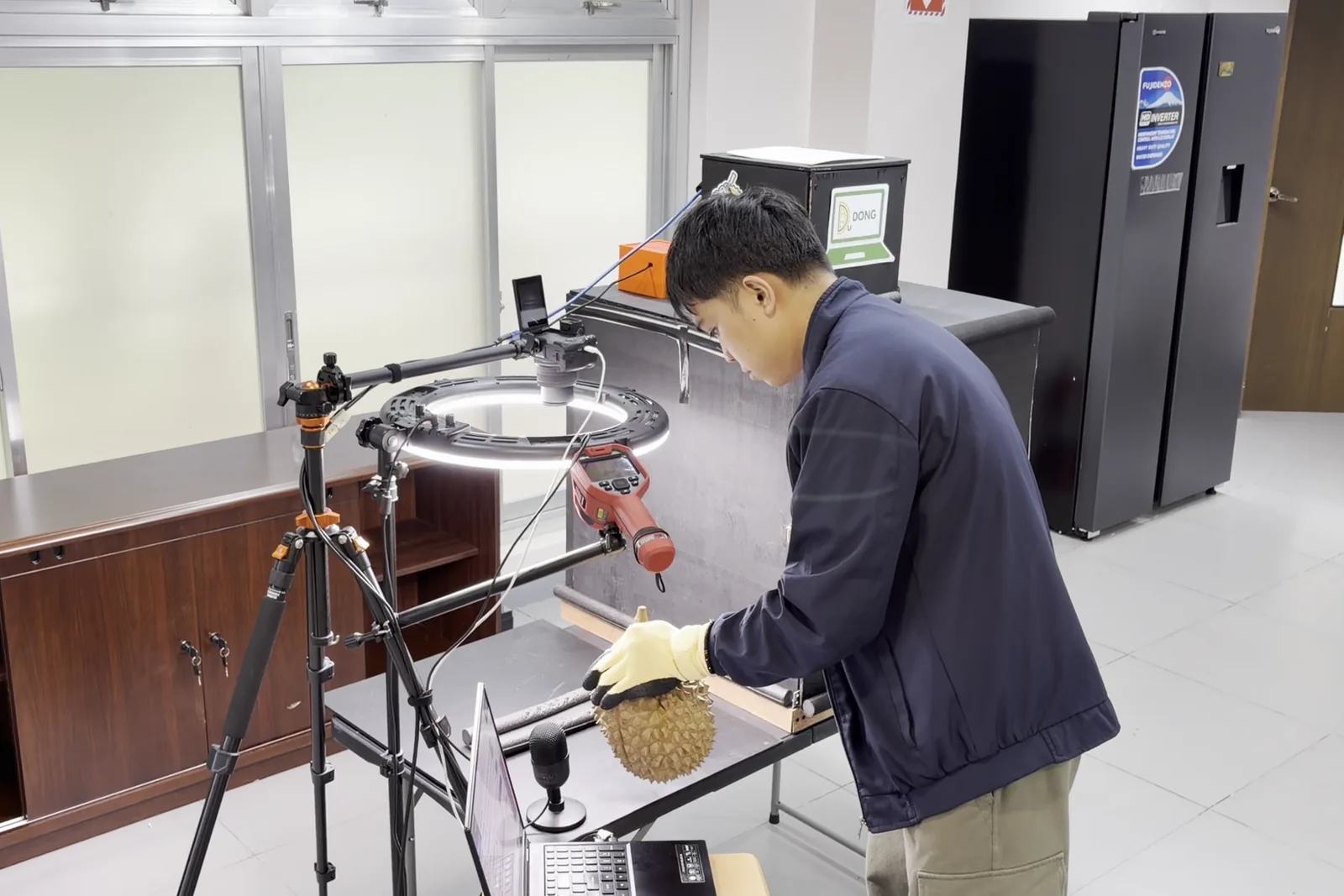
The project connects a local dataset with component models, a computer-system prototype and an economic analysis.
Collect RGB, thermal and multispectral images, acoustic recordings and fruit characteristics.
Evaluate AI methods for maturity, ripeness and quality tasks on locally collected Puyat durian data.
Bring component predictions into the INDAI mobile and DuDONG desktop applications.
Compare operating scenarios with manual grading and identify the conditions needed for adoption.
Project planning, industry consultation and initial sample collection.
Field collection, postharvest measurements, model development and partner activities.
Multimodal collection, software integration, prototype development and research dissemination.
The multimodal dataset was published in February 2026, followed by further demonstrations with partner farms. Dissemination and validation activities continue beyond the project period.