
Completion & adoption
What the project delivered.
What comes next.
A laboratory prototype, locally collected datasets and component model results. The next step is independent validation under real operating conditions.
A completed research baseline.
The project outputs establish a starting point for Puyat durian assessment. Prototype delivery and demonstrated commercial benefit are different milestones.
- Data
- 1,216 field fruits; 189 multimodal fruits
Locally collected RGB, NIR, thermal, acoustic and fruit-characteristic data. Two public dataset records support further research.
Dataset records - Models
- Five component evaluations
Maturity, ripeness, surface defects, shape and locules, with evaluation context and known weaknesses reported separately.
Results & limitations - Prototypes
- INDAI, DuDONG and the capture station
Mobile and desktop workflows connect four model tasks to image and sound capture. NIR maturity remains a separate research baseline.
Delivered prototypes - Policy & dissemination
- Research outputs and a DA-BPI recommendation
The project prepared and transmitted a recommendation on non-invasive, AI-assisted durian grading to the Department of Agriculture–Bureau of Plant Industry.
Publications & presentations
Industry engagement
Feedback from the people
who know the fruit.
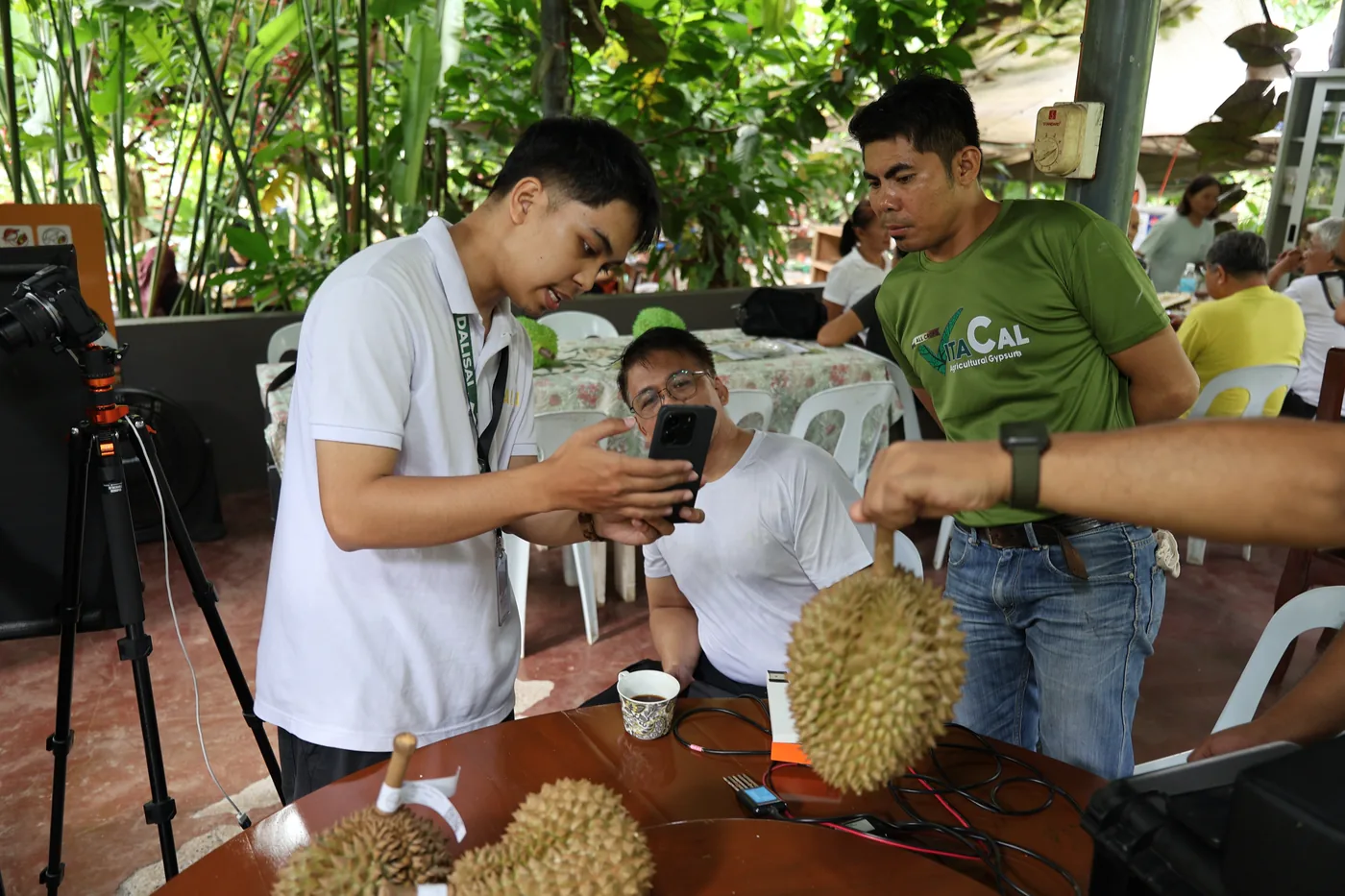
Demonstrations at Alcon Farm, Belviz Farms and D’Farmers used the partners’ own fruit. Recorded interviews at two sites captured feedback on grading and workflow needs.
These sessions provide qualitative industry feedback. They do not establish commercial accuracy, packing-house throughput or independently measured usability.
People & industry partnersAdoption needs a complete operating case.
The value of a grading tool depends on more than a model score.
Measure the workflow.
Capture time, operator effort, equipment cost and maintenance need to be assessed under normal operating conditions.
Measure the quality decision.
A partner pilot should compare grading errors and handling outcomes against current practice. Commercial savings have not been independently established.
The next research questions.
Future work needs its own protocol, partners and budget. These are the next validation priorities.